Visual Storytelling with Social Media Engagement Illustrations
Let’s be honest: the internet is noisy. If you are a marketer, entrepreneur, or content creator, you know that getting someone to stop scrolling is half the battle. Text is great for details, but it rarely stops a thumb in mid-swipe. This is where visual assets become your most valuable currency. Specifically, I am talking about the power of Social Media Engagement Illustrations. These aren't just pretty pictures; they are strategic tools designed to convey complex ideas—like connection, interaction, and digital community—in a split second.
When we talk about a "Social Media Engagement Illustration" as a design concept, we are referring to a specific style of vector art that visualizes the abstract nature of online interaction. Think about the visual metaphors we use daily: the notification bell, the "like" heart, the interconnected nodes of a network graph, or the endless stream of a news feed. A high-quality illustration file set brings these concepts to life with personality. It bridges the gap between a cold digital interface and a warm, human experience. For anyone building a brand identity in the digital space, having a cohesive library of these illustrations is not a luxury—it is a necessity for consistent visual communication.
Anatomy of a High-Impact Illustration Style
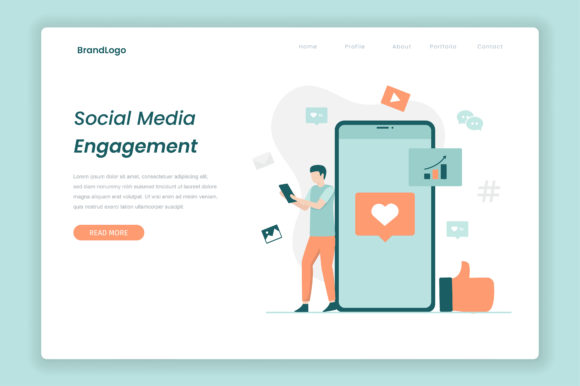
So, what does a good Social Media Engagement Illustration actually look like? It is rarely hyper-realistic. Instead, it usually relies on a modern, flat, or semi-flat aesthetic. You will see bold, confident lines and a curated color palette that avoids visual clutter. The "personality" of these illustrations is usually energetic, optimistic, and tech-savvy. They often feature stylized characters interacting with oversized devices or abstract shapes representing data and connectivity.
The appeal lies in versatility. A well-designed vector file doesn't just work on a white background; it needs to adapt. Whether you are using it for web design on a landing page or printing it on a massive banner for a trade show, the lines need to remain crisp. The style should feel contemporary without being trendy to the point of obsolescence. If the illustration feels too "cartoonish," it might undermine a serious fintech brand. If it is too abstract, it might fail to connect with a general audience. The sweet spot is a friendly, approachable aesthetic that says, "We are professional, but we are also human."
Strategic Placement: Where These Assets Shine
Understanding where to deploy your Social Media Engagement Illustration is just as important as the design itself. The utility of these assets extends far beyond your Instagram feed. Here is where I see the highest return on investment for creators and business owners:
- Website Headers and Hero Sections: Instead of a generic stock photo of people in a meeting, use an illustration to explain your software or service. It loads faster and conveys the specific action you want users to take.
- Mobile Applications: Empty states (like "No notifications yet") are perfect spots for friendly illustrations. They soften the blow of a zero-result search or an empty cart, keeping the user experience positive.
- Pitch Decks and Presentations: Editorial design isn't just for magazines. When presenting to investors or clients, these visuals help explain abstract metrics like "user engagement" or "viral loops."
- Physical Marketing: Don't forget print. These vectors are perfect for packaging design for tech startups, or posters and flyers for digital marketing conferences. Because the files usually include AI, EPS, and SVG formats, scaling up to large format printing is seamless.
The Psychology of Visual Engagement
Why does a specific illustration style matter for your bottom line? It comes down to psychology and trust. In modern typography and design, we talk a lot about "cognitive fluency"—the ease with which our brains process information. A chaotic, low-resolution image creates friction. A clean, well-composed Social Media Engagement Illustration reduces that friction.
When a visitor lands on your page and sees a cohesive visual language—where the illustration matches the tone of your font pairing and color scheme—they subconsciously perceive you as more professional. This consistency builds brand recognition. If you use the same style of illustration across your social graphics, your mobile app, and your email newsletters, you are weaving a thread of familiarity. Over time, this builds the "know, like, and trust" factor that drives conversions. It transforms your digital presence from a collection of random posts into a unified brand identity.
Practical Guide to Integrating Illustrations
If you are ready to incorporate these assets into your workflow, you need a practical approach. It is easy to get overwhelmed by the sheer number of files in a typical design asset pack. Here is how to navigate the process:
Evaluating the File Package
A professional asset pack should offer flexibility. You mentioned the standard professional formats: AI, EPS, JPEG, PNG, and SVG. This is the gold standard. As a designer or business owner, you need to know what to use when.
- SVG (Scalable Vector Graphics): This is your best friend for web design. SVGs are lightweight, load incredibly fast, and scale perfectly on any screen size, from a smartwatch to a 4K monitor.
- AI and EPS: These are your editable source files. If you have Adobe Illustrator, you can change the hair color of a character, swap out a laptop for a tablet, or adjust the color palette to match your brand's hex codes.
- PNG: Use these when you need a transparent background for quick social media posts or layering in tools like Canva or Photoshop.
Matching Style with Personality
Not all illustrations fit all brands. If your brand voice is serious and authoritative (like a law firm or a B2B enterprise SaaS), look for illustrations with minimal detail, muted colors, and realistic proportions. If you are a lifestyle blogger or a startup targeting Gen Z, you can get away with bolder colors, exaggerated proportions, and more whimsical elements. Always ask: "Does this visual style align with the typeface I am using?" A playful illustration will look jarring next to a stiff, traditional serif font, but it might pair beautifully with a casual script font or a rounded sans serif font.
Testing and Implementation
Before you overhaul your whole site, test the asset in one specific location. Swap out the header image on your landing page and monitor your bounce rate. Use the illustration in a Facebook ad versus a stock photo and compare the Click-Through Rate (CTR). Real-world data is the only way to know if a visual asset is actually working. Also, consider accessibility. Ensure there is enough contrast between the illustration and the background, and always use alt text for SEO and screen readers.
Conclusion: Elevating Your Creative Assets
In the crowded digital landscape, generic visuals are invisible. Investing in high-quality Social Media Engagement Illustrations is an investment in clarity and professionalism. Whether you are a freelancer building a portfolio, a marketer running a campaign, or a small business owner trying to explain a complex service, these visual tools allow you to communicate faster and more effectively. By choosing files that are versatile, style-appropriate, and professionally formatted, you ensure that your brand looks cohesive across every touchpoint—from the smallest mobile screen to the largest printed banner.